Short··0:45·Combinatorics
5 Maths Problems OpenAI Says Its AI Just Solved
Watch on YouTubeRead the write-up →
About this video
OpenAI claims its models proved these five results. Which one broke your brain?
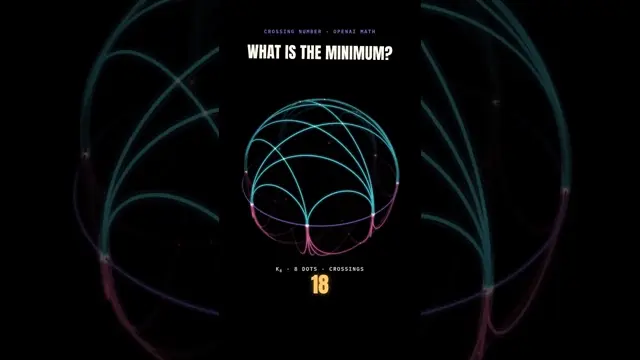
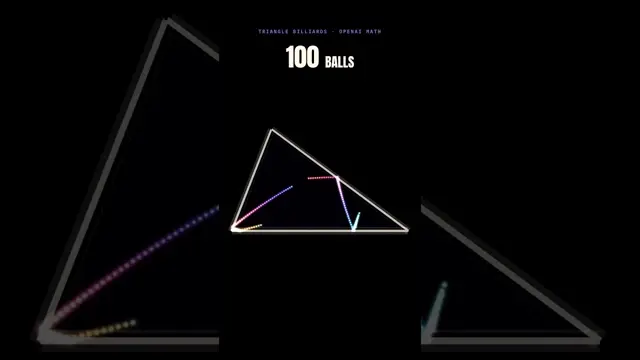
1. Crossing numbers: link 18 dots on a sphere and you get 1008 crossings. OpenAI claims no drawing ever beats the classic one (Harary-Hill).
2. Colouring the plane: points 1 apart must get different colours. 7 colours work. OpenAI claims 5 never can, so the answer is 6 or 7.
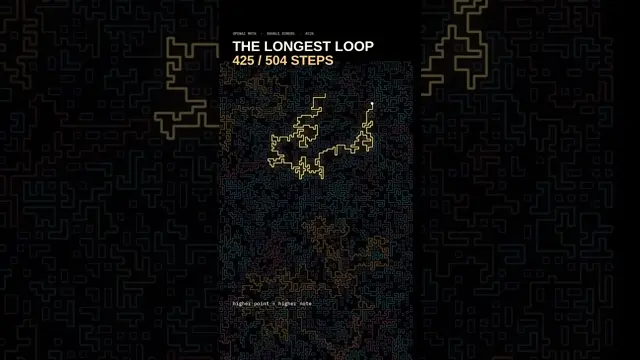
3. Self-avoiding walks: an 8000-step honeycomb walk that never touches itself. OpenAI claims its size grows like steps to the 3/4.
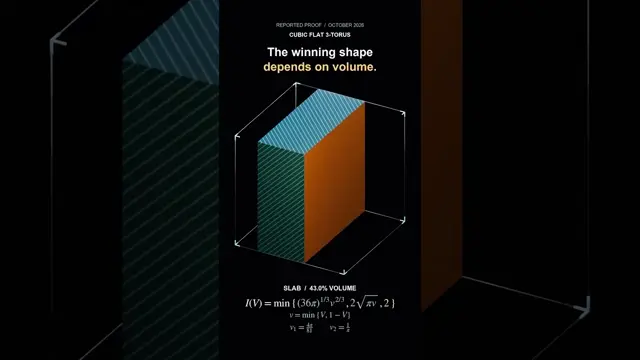
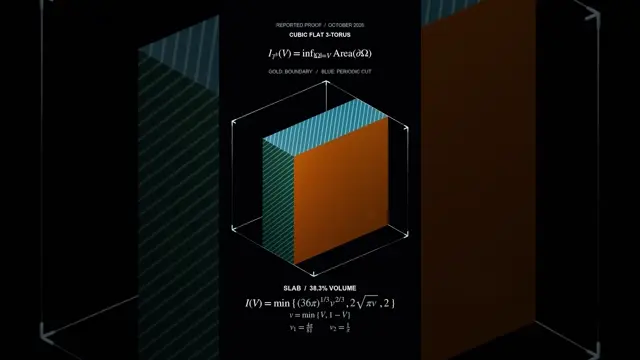
4. Bubbles in a 3-torus: the least-area shape for each volume in a cube with opposite faces glued is a ball, then a tube, then a slab. OpenAI claims a proof of the full answer.
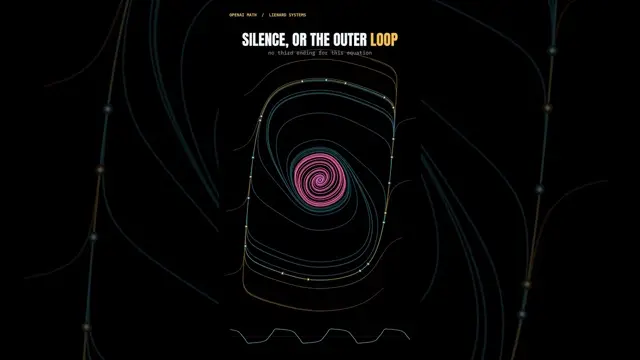
5. SLE curves: one random path, three roughnesses. OpenAI claims the exact ruler that measures them.
The animations are illustrations, not the proofs. The claims and papers are in OpenAI's public maths catalogue: github.com/openai/math (families 165, 158, 237, 354, 230). Results are as reported by OpenAI and not independently verified here.
Visuals and music are original, generated from the same event clock.
About the problem
Combinatorics·OpenAI Math·Result 165
The Harary–Hill and Zarankiewicz crossing-number formulas
Resolves the Harary–Hill conjecture and Turán's brickyard problem in the Zarankiewicz formulation, determining the crossing numbers of every complete and complete bipartite graph. The result proves the optimality of the classical drawings among all plane drawings with continuous edge arcs. (Lean)
About the problem
Combinatorics·OpenAI Math·Result 158
The Euclidean plane cannot be colored with five colors
Proves that every five-coloring of the Euclidean plane has a monochromatic pair at distance one, with no restriction on the color classes. This advances the Hadwiger–Nelson problem: together with the classical seven-coloring, only six and seven remain possible chromatic numbers of the plane. (Lean)
About the problem
Probability and statistical mechanics·OpenAI Math·Result 237
The three-quarter exponent for honeycomb self-avoiding walk
Proves the diameter form of Nienhuis's predicted three-quarter exponent: a uniformly chosen n-step self-avoiding walk on the honeycomb lattice has diameter n3/4+o(1). Its local mass and covering numbers have exponent 4/3. These estimates hold at every sufficiently large fixed length, simultaneously across scales, with arbitrarily high polynomial probability. (Lean)
About the problem
Differential geometry·OpenAI Math·Result 354
The isoperimetric profile of the cubic three-torus
Determines the isoperimetric profile of the unit cubic flat three-torus and classifies every finite-perimeter minimizer: balls, circular tubes around shortest closed geodesics, coordinate slabs, and their complements. The transition volumes are 4π/81 and 1/π, with exactly the adjacent two types minimizing at each transition. (Lean)
About the problem
Probability and statistical mechanics·OpenAI Math·Result 230
Exact Hausdorff gauges for SLE
Resolves Schramm’s Hausdorff-measure question for chordal SLEκ, 0 < κ < 8. The explicit gauge rd(log log(1/r))(2-d)/2, d=1+κ/8, gives almost surely positive finite measure to every trace segment γ([s,t]) with 0 < s < t < ∞, and finite expected measure to the trace in every bounded disk. (Lean)
Topics
mathsmathopenaiai mathscrossing numberharary hillchromatic number of the planehadwiger nelsonself avoiding walkhoneycomb latticeisoperimetric problemflat torusschramm loewner evolutionSLEproofsai proofs