Short··0:37·Probability and statistical mechanics
Two random tilings make these loops
Watch on YouTubeAbout the problem →
About this video
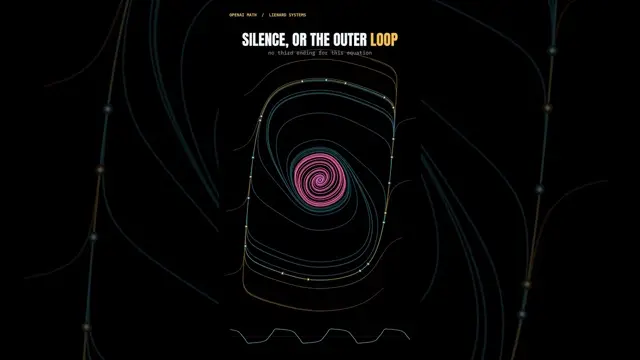
Lay two random domino tilings on top of each other, delete every domino they share, and only loops are left.
Here two independent uniformly random tilings of a 127 x 207 Temperleyan rectangle, one cyan and one gold, leave 1,721 loops. The longest loop is traced, then all of them ring from smallest to largest. Each domino plucks a note as it lands: higher on screen, higher note. Small loops ring high and big loops ring low.
OpenAI, ChatGPT's creator, reports a proof that the complete double-dimer loop ensemble for the Temperleyan square lattice in the upper half-plane converges to nested CLE4. This is a source-reported result, not independently reviewed or proof-audited in this production, and the public ChatGPT product is not claimed to have proved it. The animation shows one finite random sample as an illustration, not the proof; the paper works in the half-plane scaling limit.
Source manuscript:
The Curve Scaling Limit of Half-Plane Double Dimers
github.com/openai/math/blob/main/preprints/The-curve-scaling-…
Corrections and withdrawals: github.com/openai/math/blob/main/history.md
Sound and visuals: original code-generated synthesis and animation. No third-party samples or compositions. Native 2160x3840 at 60 fps.
Gradient Damage: mathematics you can see, equations you can hear.
Visual maths, 3D animation and sound experiments.
youtube.com/@gradientdamage
About the problem
Probability and statistical mechanics·OpenAI Math·Result 226
The double-dimer loop ensemble converges to CLE4
Resolves the half-plane Temperleyan form of the double-dimer scaling-limit conjecture: the complete loop ensemble formed by two independent dimer coverings of the Temperleyan square lattice converges to nested CLE4. Convergence matches every macroscopic loop as an unparametrized curve, upgrading convergence of loop observables to convergence of the loops themselves.
Topics
domino tilingsdouble dimer modelrandom tilingsCLE4OpenAI mathmath animation